

- This event has passed.
NEW! DISLOCATION & DIVERGENCE: E. O. 9066 at the MIS Historic Learning Center
January 1, 2020 at 4:00 am - December 31, 2020 at 9:00 am
NEW INSTALLATION- Dislocation & Divergence: Causes & Consequences of E.O. 9066
at the MIS Historic Learning Center
2020
NJAHS presents 3 new wall-installations capturing 5 episodes of World War II: War Clouds Brewing, America Enters the War, Exclusion & Removal, Hidden Truths, Hidden Treasures
This completes a two & a half year exhibition project funded in part by grants from the Japanese American Confinement Sites Grant program administered by the National Park Service and the JA Community Foundation and CA Civil Liberties Public Education Program.
The period scenarios with artifacts allow for an intimate “walk back in time,” matched with IPAD pro interactive technology which allows for a “deeper” dive into the analysis of what happened and why. There’s a new addition that looks at the discovery of key evidence from the 1980’s coram nobis legal cases of Korematsu, Yasui, & Hirabayashi which revealed suppression of evidence, a cover up, and fraud upon the Supreme Court. Step inside and discover!
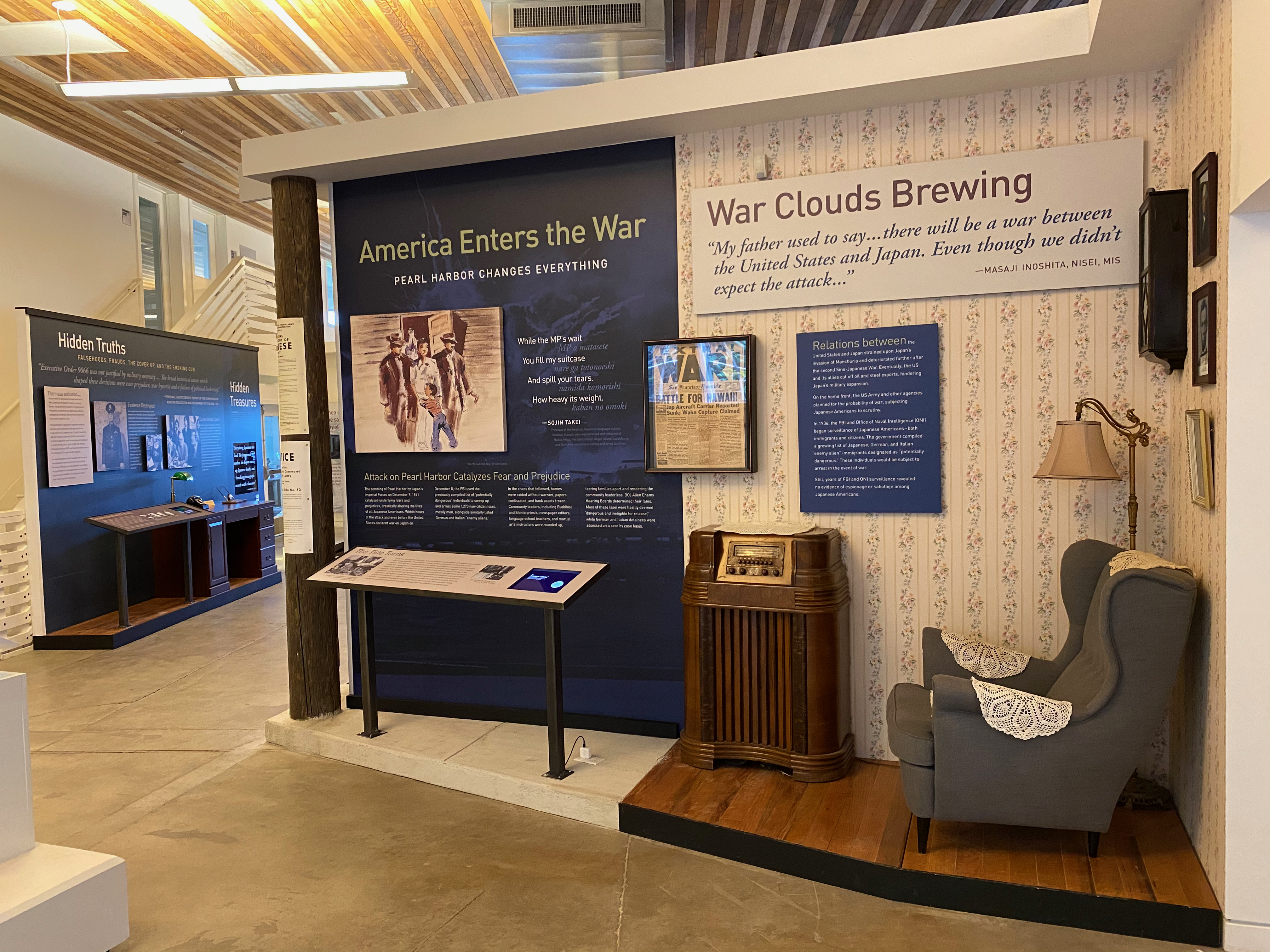
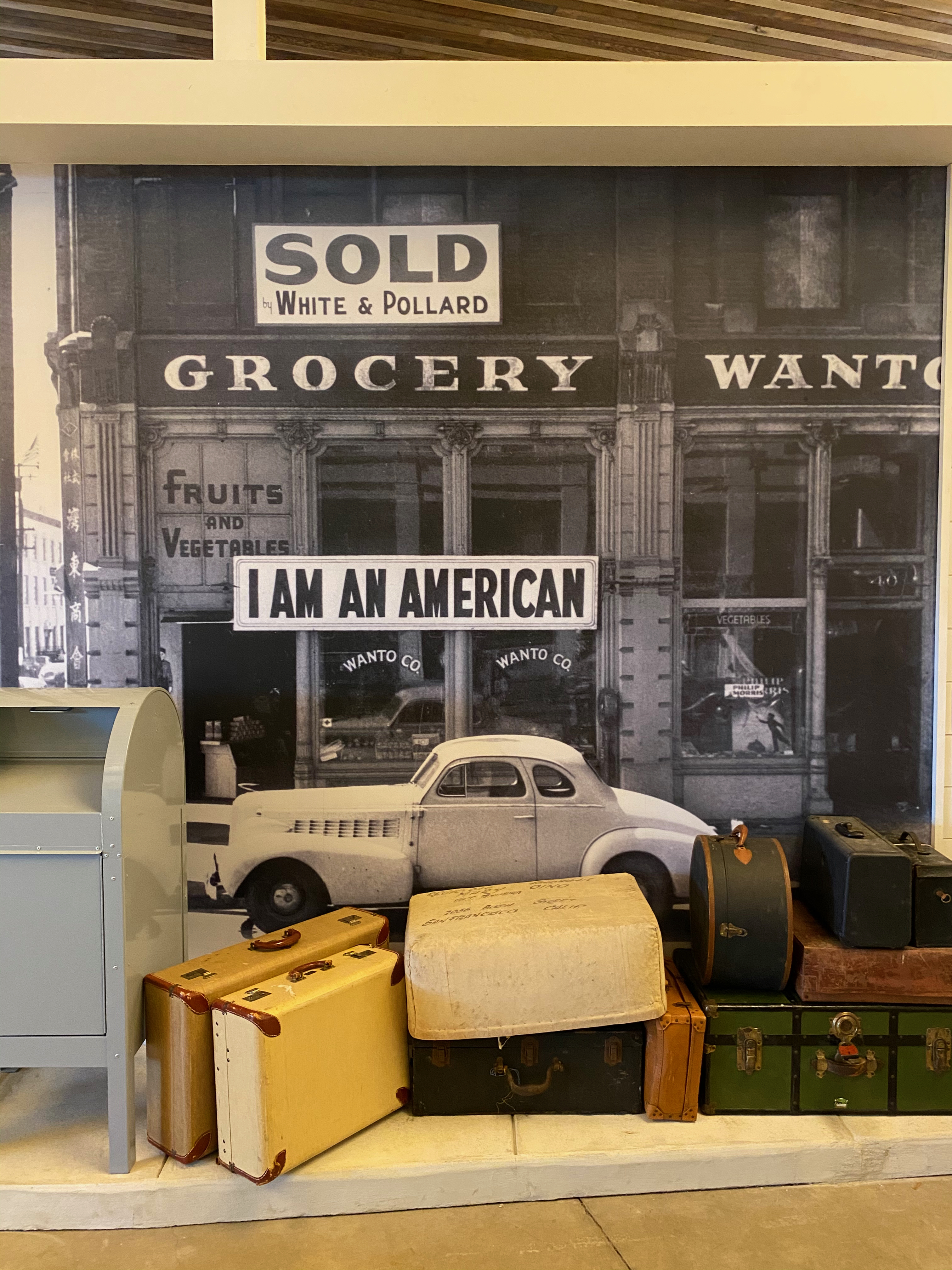
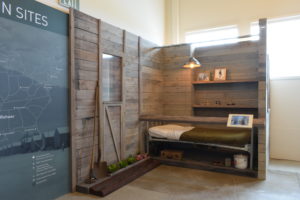
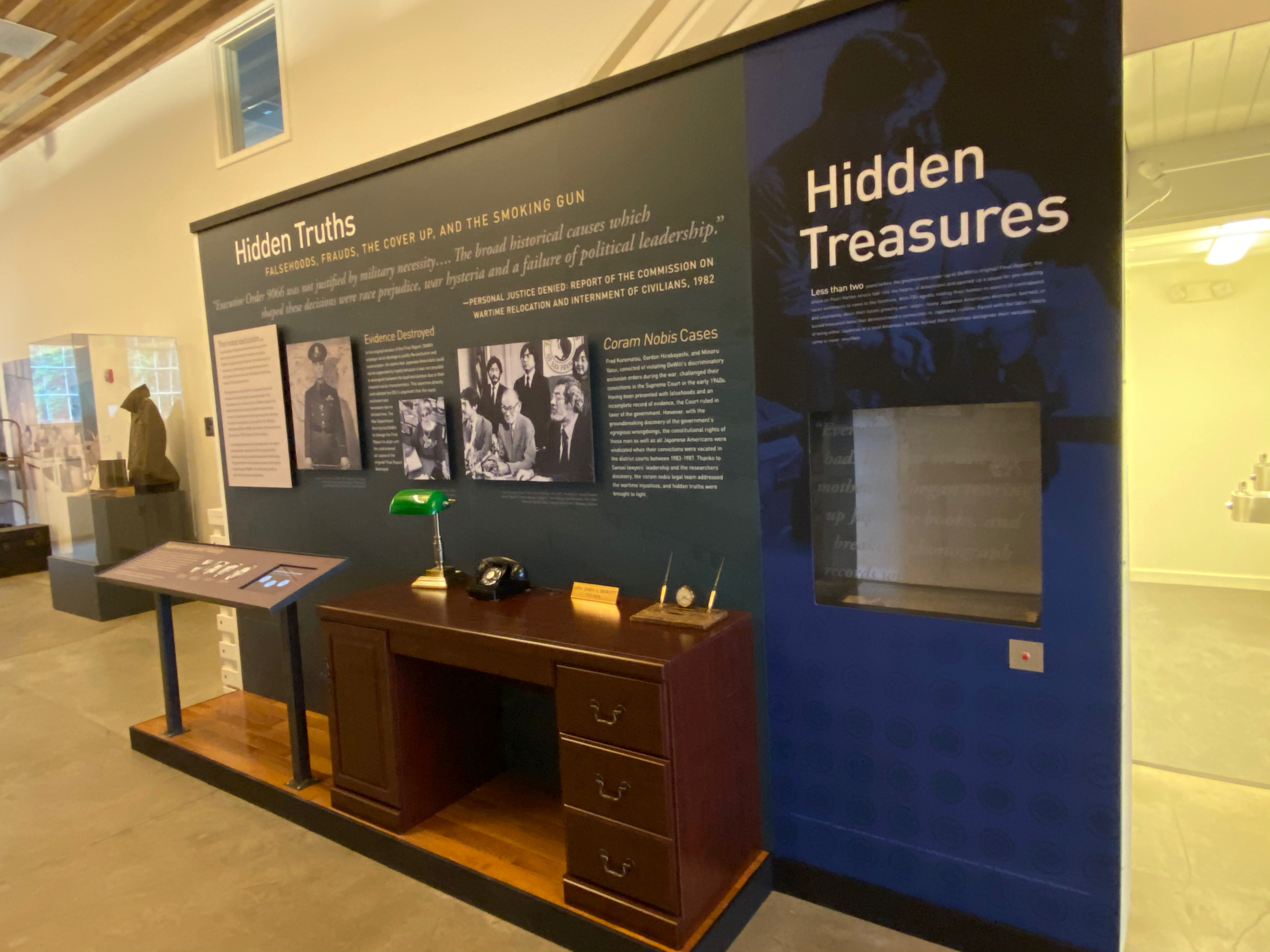
9-19-2018: The National Japanese American Historical Society announced the completion of a simulated horse stall barrack for its Dislocation and Divergence new installation at the MIS Historic Learning Center, located at Crissy Field in the Presidio of San Francisco. The mock-up replicates the WWII experience of some 110,000 Japanese Americans forcibly removed from their homes due to military orders pursuant to the signing of Executive Order 9066.
Real Stories
According to project director Rosalyn Tonai, “We decided to introduce audiences to the compelling experiences of two families, one of famed artist and essayist Miné Okubo, and the other of MIS First Class Nisei soldier Tsuneo Gary Kadani.” Miné Okubo, in her illustrated publication Citizen 13660, relays her personal removal and incarceration with painstaking detail to a horse stall at Tanforan “Assembly” Center, in San Bruno, California. “We wanted to replicate the cramped quarters and the sense of humiliation felt by the author, according to Tonai. In addition, the plight of Gary Kadani’s parents are revealed in his oral history excerpts compiled in First Class: Nisei Linguists of World War II, Origins of the Military Intelligence Service Language Program of World War II (David Swift, Jr., NJAHS, 2008).
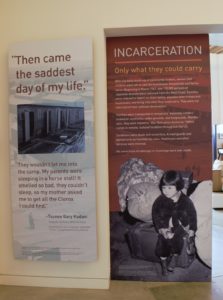 Tsuneo Gary Kadani was an early enlistee into the US Army. A month prior to Pearl Harbor, he was assigned to the top secret US Army intelligence school at the Presidio of San Francisco in preparation for war against Japan. When WWII broke out, he along with 59 other MIS servicemen continued their studies at the Presidio while their families were subjected to curfew and forcibly removed from their home, and incarcerated in makeshift, hastily built barracks and horse stalls in fairgrounds and racetracks. Gary disobeyed curfew, and drove to see his parents at the Salinas fairgrounds. His famous quote at the front of the display recounts his feelings that day “Then came the saddest day of my life…They wouldn’t let me into the camp. My parents were sleeping in a horse stall! It smelled so bad, they couldn’t sleep, so my mother asked me to get all the Clorox I could find.” A vintage 1940’s brown glass Clorox bleach bottle helps depict the circumstances in which many Japanese Americans found themselves.
Real Objects & Evidence
Adding to the overall visitor experience is Miné Okubo’s illustrations from Citizen 13660. The visitor can follow along, seeing Miné’s camp life depictions and reading excerpts of her journal, through digital displays on an iPadPro. Interwoven into the pages of Citizen 13660 are National Archives photographs of life in repurposed horse stalls and barracks of Tanforan, Santa Anita, and Salinas “Assembly Centers.” The iPad also helps guide audiences to explore the stories behind real camp artifacts on display inside the horse stall barrack, many of them, personal items belonging for former inmates. Some featured objects include Ken Nihei’s US Army-issued military green wool blanket laid over a hay-stuffed mattress, personal shaving kit, 4 year old Pat Kimura’s of Maryknoll Children’s Home child’s suitcase, a diaper pail, and a pair of mud- caked hand-carved Japanese wooden clogs (geta).
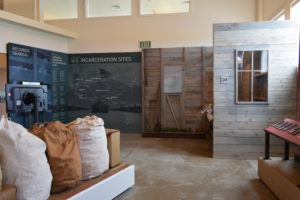
Supplementing the Horse stall barrack display is a comprehensive Camp Map of where Japanese Americans were incarcerated. The map includes the ten War Relocation Authority centers, the fifteen “Assembly Centers – the temporary detention facilities.as well as the numerous Department of Justice internment camps for Japanese immigrants deemed “enemy aliens.”
Perseverance
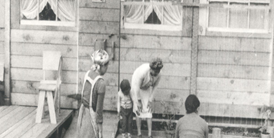
“We wanted to show how some inmates coped within the stifling conditions of their confinement,” noted Tonai. While many were subjected to family separations due to the earlier FBI raids, and met with unhealthy conditions of open sewers, others tried to find solace relying on friends and community. Among the few belongings of only what they could carry, many Issei women stashed their vegetable garden seeds into their pockets. In time, little front porch “victory” gardens would sprout along the stoops of barracks. Later, inmates were moved again in six months to the permanent camps in desolate regions of the US. Despite the trauma, children would find time to play, collect and trade marbles. One former incarceree, Toru Saito, rediscovered his prized marbles buried beneath the silt desert floor where the stoop of his barrack once stood. Toru’s marbles and his story of survival are on display.
The horse stall barrack replica of the Dislocation and Divergence new installation is now on display at the Military Intelligence Historic Learning Center, at the Presidio of San Francisco, Building 640, 640 Mason Street, San Francisco, CA 94129. The interpretative center is open to the public. General admission is $10. Admission is free to veterans, NJAHS members, and children 12 and under. Free education programs are available to teachers. The project has been funded by a grant from the California Civil Liberties Public Education Program, administered by the California State Library and the JA Community Foundation.
###