
Research on 100th/442nd Regimental Combat Team
100th/442nd Regimental Combat Team
When the United States entered World War II in 1941, there were 5,000 Japanese Americans in the U.S. armed forces. Many were summarily discharged. Those of draft age were classified as 4-C, “enemy aliens,” despite being US citizens.
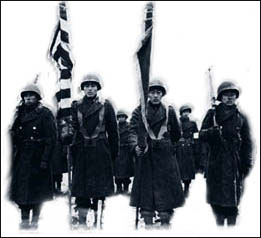
In Hawaii, however, a battalion of Nisei soldiers drafted pre-war was formed in May 1942. As the 100th Infantry Battalion, they were sent to North Africa in September of 1943 where they joined the 34th Infantry Division in combat in Italy. In the following five months, they saw fierce combat and came to be known as the “Purple Heart Battalion” due to their high casualty rate.
In January 1943, the US War Department announced the formation of the segregated 442nd Regimental Combat Team (RCT) made up of Nisei volunteers from Hawaii and the mainland. In June of 1944, the 442nd joined forces with the 100th Infantry Battalion in Europe and incorporated the 100th into the 442nd. Due to the stunning success of the 100th Infantry Battalion in combat, the draft was re-instated in January 1944 for Nisei in the country to bolster the ranks of the military units. Eventually, the 442nd RCT consisted of the 2nd, 3rd, and 100th Battalions; the 522nd Field Artillery Battalion; the 232nd Engineering Company; the 206th Army Band; Anti-Tank Company; Cannon Company; and Service Company.
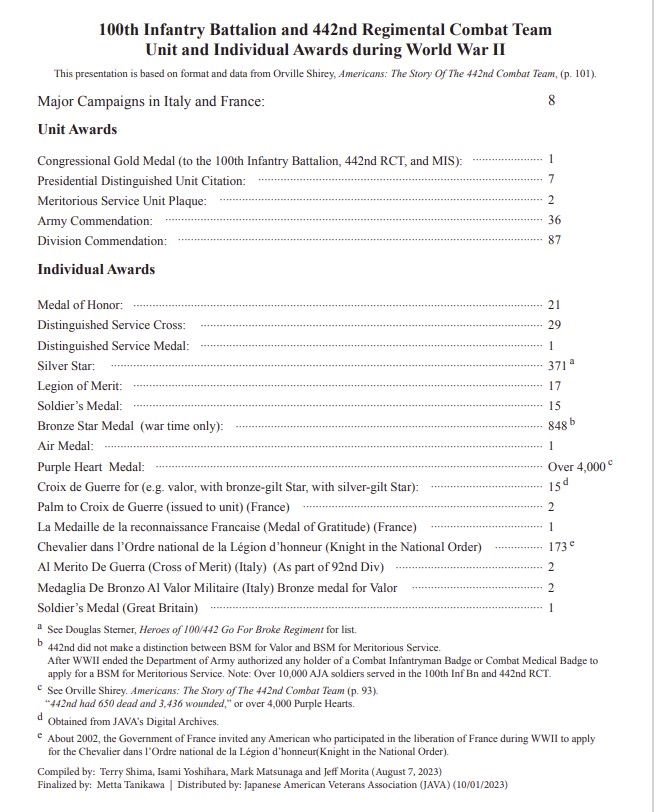
Due to their outstanding bravery and the heavy combat duty they faced, the 100/442nd RCT became one of the most decorated units in U.S. military history for its size and length of service. There were many individual decorations for bravery, over 4,000 Purple Hearts, and seven Presidential Distinguished Unit Citations.